50 days with OpenClaw: The hype, the reality and what actually broke
AI and agents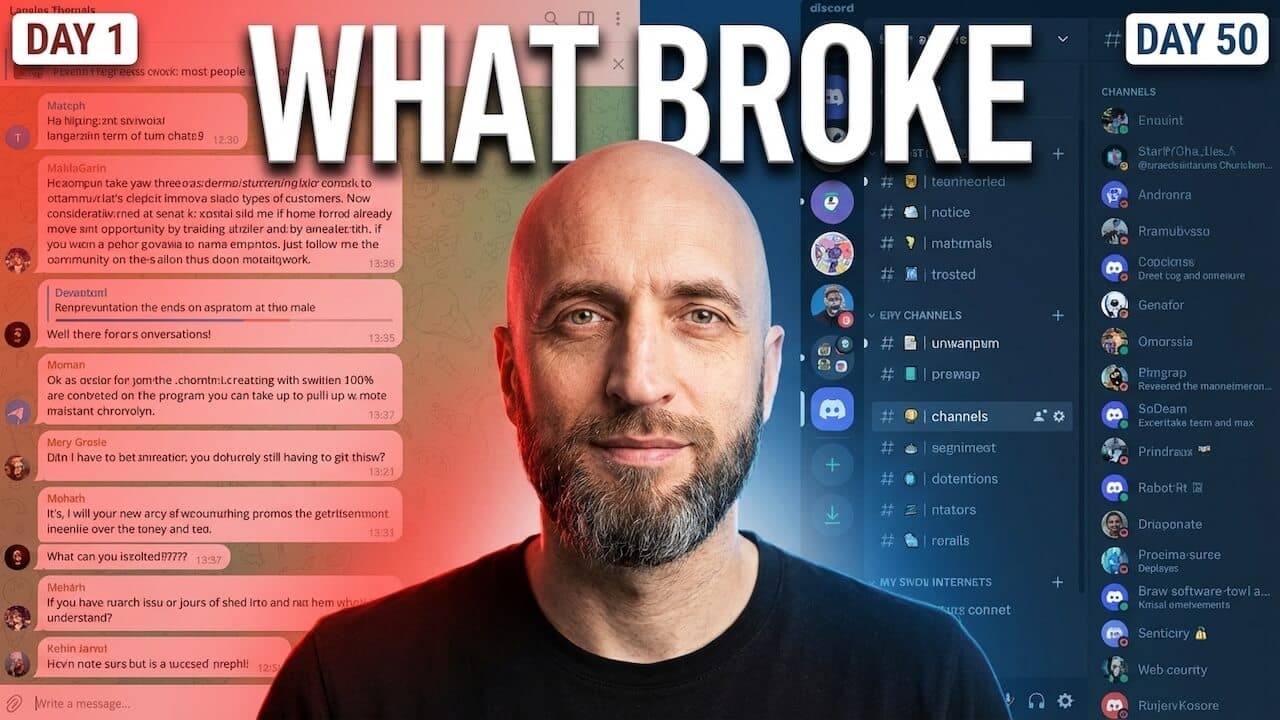
Most OpenClaw content right now is first-week impressions. Or setup tutorials. Or people showing use cases after three days of usage.
Nobody can tell you what happens after the first month. Because they haven't been there yet.
I have. Every single day. For over 50 days. Through every single iteration of this tool: ClawdBot, Moltbot, OpenClaw.
I made the setup video that ended up in the official OpenClaw documentation. I built Clawdiverse, the community directory of use cases. I created a skill that's listed on ClawHub.
And the most common post on Reddit is still: "I set up OpenClaw but don't know what to use it for."
This article is the answer. Twenty real use cases from my daily life, plus the honest truth about what breaks, how it breaks, and what to do about it.
Quick context
If you're new here: OpenClaw is an always-on AI agent that runs on your server, VPS, Mac Mini, even a Raspberry Pi. Twenty-four seven. It connects to your messaging apps (Telegram, WhatsApp, Discord, iMessage) and can do anything you can do on a computer: email, calendar, browse the web, write code, manage your server, control smart home devices.
Every prompt for every use case I'm about to show you is in this GitHub Gist. Ready for copy-pasting.
My 3 principles after 50 days
Before the use cases, here's what 50 days actually looks like. The way you use this thing in week one is nothing like week seven.
Week one is novelty. You're asking it random questions, testing what it can do. But one decision I made from day one saved me over and over: markdown-first. A lot of people build workflows around SQLite databases, vector stores, custom schemas. I put everything in Obsidian, in plain text files. Any person can read them. Any program can work with them. When the next thing after OpenClaw comes along, my data moves with me in five seconds. No lock-in. Just files.
Week three, you start building automations. Morning briefings, background checks. It starts being more useful.
Week five, you hit a wall. Everything is in one conversation. Research mixed with bookmarks. Analytics mixed with daily tasks. Context pollution. That's when I learned: separate contexts. One Discord channel per workflow. Research doesn't bleed into analytics. Bookmarks don't pollute daily assistant tasks.
Week seven, another lesson. Not every channel needs the same brain. Match the model to the task. Opus for deep thinking. Cheap models for routine work. That's when costs stop being scary.
By week eight, it stops being a chatbot and becomes a system.
Use case map
Twenty use cases across six categories. I'm going to move fast: real screenshots, real conversations, real results.
| Category | Count | Use cases |
|---|---|---|
| Daily automations | 3 | Morning briefing, AI art, self-maintenance |
| Always-on checks | 1 | Background health checks |
| Research and content | 3 | Parallel sub-agents, content machine, web summaries |
| Infrastructure and DevOps | 2 | Server monitoring, coding from phone |
| Daily life assistant | 5 | Email, calendar, voice notes, coffee, weather, reminders |
| Discord, knowledge base, creative | 6 | Migration, bookmarks, Obsidian, fun stuff |
If you only steal three ideas from this entire article, I'll tell you exactly which three at the end.
Part 1: Daily automations
Things that run every day without me touching anything.
Use case #1: The morning Twitter briefing
Every morning at 7am, my agent scans tweets from accounts I follow, picks the top 10, writes them to my Obsidian notes, appends any video ideas to my shipping backlog, and sends me a summary.
I wake up and I don't need to scroll through the feed to know what happened. The most important parts are already waiting for me, tailored to my interests.
One cron line. That's the setup. The value compounds because it doesn't just summarize. It connects dots. "Hey, this tweet about model pricing connects to your video idea about cost optimization." That kind of thing.
Setup: Easy | Value: High
Use case #2: "Moment Before" - daily AI art for my e-ink display
[PLACEHOLDER IMAGE: TRMNL display showing the woodcut-style AI art]
This is my favorite use case. Every morning at 5:30am, my agent fetches Wikipedia's "On This Day" events, picks the most impactful historical event, and generates a woodcut-style image showing 10 seconds BEFORE the event happened.
The iceberg approaching the Titanic. The apple about to fall on Newton's head.
It pushes to my TRMNL e-ink display in mystery mode. Only shows the date and location. You guess the event.
This is part of my daily ritual now. Walk past the display, look at the new picture, try to guess, learn something about history. Every single day, a new one waiting.
Setup: Medium | Value: High
Use case #3: Self-maintenance - updates and backups
Two cron jobs that I never think about.
Every day at 4am, my agent updates its own skills from ClawHub, updates the OpenClaw package itself, restarts the gateway, and reports the results. When something breaks during an update, it tells me. When everything works, I get a one-line confirmation.
And every day, a separate cron job backs up everything important. All configuration files, workflow definitions, cron schedules, SOUL.md, MEMORY.md, skills. Everything that defines how my agent works.
If my server dies tomorrow, I'm back up in an hour. Not rebuilding from scratch. Just restore and go.
Setup: Easy | Value: High
Part 2: Always-on checks
Background guardrails that catch drift.
Use case #4: Background health checks
[PLACEHOLDER IMAGE: Discord alerts showing Netflix payment failure, domain renewal, meeting reminders]
This used to feel like the headline feature. Now I think of it as background guardrails. Useful, but only one slice of the system.
My agent runs heartbeat checks every 30 minutes. It scans my emails, checks my calendar, monitors my services. And it catches things I would have missed.
A Netflix payment failure. I had no idea. Found during a routine email scan.
Domain renewal coming up. A meeting I was about to miss. A relevant newsletter article found during a Sunday heartbeat scan that connected to a video I was planning.
None of these were tasks I assigned. My agent found them.
The things that normally fall through the cracks? That's exactly what gets caught.
The key insight here is draft-only mode for email. It reads my inbox, flags what's important, drafts responses. I review and send. There's no robust, general solution yet for prompt injection via email, so I treat inbox content as potentially hostile. Draft mode is the sweet spot. It prepares, I approve.
Setup: Medium | Value: High
Part 3: Research and content creation
Use case #5: Research agent with parallel sub-agents
[PLACEHOLDER IMAGE: Screenshot of research output files showing the massive structured research documents]
This one is wild.
For this video, I told my agent to research what people are doing with OpenClaw. It spawned 10 parallel sub-agents. One searched Twitter. One crawled Reddit. One hit Hacker News. One analyzed YouTube competition. One scraped community sites.
They all ran simultaneously and produced massive, structured research files. Competitive analysis, ranked video ideas, full outlines with source links. In minutes, not hours.
The research files for this video alone are over 50 pages. And it gave me a clear understanding of what people are doing and, more importantly, not yet doing with OpenClaw.
Setup: Easy | Value: Very High
Use case #6: Content machine - YouTube stats and video research
[PLACEHOLDER IMAGE: Discord channels showing YouTube analytics queries and accumulated research]
I have two dedicated Discord channels for content creation.
The first is my YouTube analytics channel. It has access to all my stats and I can query anything in natural language. "How did my last five videos compare on retention?" "Which topics get the most engagement?" "Compare my OpenClaw videos to my Claude Code videos."
It slices and dices the data any way I want, on demand. Much more flexible than YouTube Studio's built-in dashboards. It also synthesizes the numbers and gives ideas and advice based on that.
The second is my video idea research channel. Throughout the week, I drop links, articles, tweets, half-formed thoughts. The agent enriches them, connects dots across sources, builds context over time.
By the time I sit down to script a video, I don't start from zero. I have weeks of accumulated, organized research waiting.
The separation matters. Analytics context stays isolated. Research builds over weeks without polluting other conversations.
Setup: Medium | Value: High
Use case #7: Web summaries and the /summarize command
Throw any URL at it (an article, a YouTube video, a research paper) and get a summary back. I use this multiple times a day.
No prompt needed. This is a built-in skill you can install during onboarding or from ClawHub. Just type /summarize [URL] and you get a structured summary back automatically. Works with articles, YouTube videos, research papers, PDFs, anything with a URL.
Setup: Easy | Value: Medium
Part 4: Infrastructure and DevOps
Use case #8: Infrastructure and DevOps
[PLACEHOLDER IMAGE: Discord conversation showing Coolify inventory, unhealthy service flag, terminal commands]
My agent migrated me from the old Clawdbot package to OpenClaw. Found both packages running at the same time. Killed a zombie process running at 159% CPU. Deleted old system services. Fixed seven days of silently broken cron jobs.
All from one message: "go fix everything."
It's connected to my Coolify server via API. Inventoried 20+ apps. Flagged an unhealthy Plausible analytics service with a broken ClickHouse container that I had no idea about. Set up VNC remote desktop access. Kept restarting a memory-killed embedding process until it finished.
A day of SRE work done in a conversation.
Setup: Medium | Value: High | Risk: Medium
Use case #9: Coding from my phone
[PLACEHOLDER IMAGE: Discord conversation showing code change request from mobile]
I can tell my agent to fix a bug, build a feature, create a PR. All from my phone while I'm away from my desk.
You don't need your laptop. Your AI has your laptop.
To be completely honest, I don't use it for production as my main way of programming. I only use it for quick fixes or simple ideas that come to mind and I want to test on the go. For my main workflow I still use Claude Code and Codex.
Setup: Easy | Value: Medium
Part 5: Daily life assistant
Use case #10: Email triage and draft replies
[PLACEHOLDER IMAGE: Email draft prepared by the agent]
Beyond the proactive catches I already showed you, the day-to-day email workflow is simple: it reads my inbox, flags what's important, and drafts responses. I review and send.
Draft-only mode. It prepares, I approve. Thirty minutes a day, easy.
Setup: Medium | Value: High | Risk: Medium
Use case #11: Calendar and family management
[PLACEHOLDER IMAGE: Discord conversation adding calendar event]
"Schedule dentist Thursday at 3pm." Done.
I set up Google Calendar integration for myself and for my wife via a group chat in WhatsApp. She can add events, check the schedule, get reminders. All through the same chat interface.
Simple. But once it works, you start asking "what else can it do?"
Setup: Medium | Value: Medium
Use case #12: Voice note transcription
Send a voice message on WhatsApp, Telegram or Discord. It transcribes it with Whisper and responds in text. Quick thoughts while driving, shopping lists while walking, meeting notes on the go. Just talk, it handles the rest.
Setup: Easy | Value: Medium
No prompt needed. During onboarding, enable the Whisper transcription skill. After that, any voice message you send in WhatsApp, Telegram, or Discord is automatically transcribed and the agent responds to the content in text.
Use case #13: Daily life - coffee shops, weather, reminders
[PLACEHOLDER IMAGE: Montage of coffee shop recommendation, weather forecast, reminders]
"Find me a good coffee shop within walking distance." It uses Google Places API: ratings, reviews, walking distances from my home.
Seven-day weather forecast. It warned me about a minus 19 degrees cold snap coming up.
Rehab exercise reminders every day, with snooze capability. Meeting reminders before weekly calls.
Small things on their own. But they add up.
Setup: Easy | Value: Medium
Use case #14: Helping friends set up in a group chat
[PLACEHOLDER IMAGE: WhatsApp group chat screenshots showing agent helping in Polish]
This one is personal. My friend wanted to set up his own OpenClaw. I added him to a WhatsApp group with my agent.
My agent spent 3+ hours guiding him through the entire setup. In Polish.
npm permissions, WhatsApp linking, daemon config, Claude authorization debugging. A whole saga. All via screenshot reading in the group chat. My friend would take a screenshot of an error, my agent would read it and explain the fix.
What previously I would have had to answer myself, my agent answered 90% of the questions. I just added context from my own experience to some answers.
After a few days, when my friend installed his own instance, the questions stopped. Because he switched to asking his own agent. I didn't have any technical question from him in weeks. I only hear updates from time to time about what kind of automations he's able to do. And for a non-technical user who runs an accounting company, I'm amazed how quickly and how far he has gone already.
Setup: Easy | Value: High
Part 6: Discord migration and workflow evolution
Use case #15: The Discord migration
[PLACEHOLDER IMAGE: Discord server layout showing multiple channels; before/after graphic showing Telegram single thread vs Discord architecture]
This is one of the biggest changes in my setup over the last 50 days.
I started on WhatsApp. Then quickly moved to Telegram. Most people start on Telegram too. But around week five, I hit a wall. Everything was in one conversation. My YouTube stats were mixed with my bookmarks. My research was mixed with my daily assistant tasks. Context was getting polluted.
So I migrated to Discord. Night and day difference.
Instead of one conversation or multiple separate agents, I have channels. Each channel is a dedicated workspace with its own context.
There's a channel for YouTube analytics. A channel for video idea research. An inbox channel for bookmarks. A general channel for daily assistant stuff. Each one stays focused.
The important part is that I can set different models per channel. My YouTube stats channel uses a cheaper model because it's mostly data retrieval. My research channel uses Opus because I need deep thinking. My inbox channel uses a fast, cheap model because it's just processing links.
That's how you keep costs down. Match the model to the task.
Switching to Discord wasn't about the app. It was about the architecture. Separate contexts, cleaner conversations. Per-channel models, lower costs. I always know where to go for what.
That's what 50 days looks like. You stop using the tool and start designing how you interact with it.
Setup: Medium | Value: Very High
Use case #16: Discord bookmarks replacing Raindrop
[PLACEHOLDER IMAGE: Discord inbox channel showing enriched bookmarks]
I used to use Raindrop for bookmarks. Paid subscription, separate app, manual tagging.
I even built a system that was regularly pulling the bookmarks from Raindrop using the API and putting them in my Obsidian.
But now I just drop any link into my Discord inbox channel. The agent does the rest.
It summarizes the content, extracts key information, tags it, and over time builds a knowledge graph connecting related links. All in markdown, all searchable, all building context over time.
And it runs on a cheaper model because link processing doesn't need Opus.
I cancelled Raindrop and I don't miss it.
Setup: Easy | Value: High
Part 7: Knowledge base and Obsidian
Use case #17: Knowledge base with Obsidian and QMD
[PLACEHOLDER IMAGE: Obsidian with QMD semantic search demo]
Here's where the markdown-first thing pays off.
I have 2,800 notes in Obsidian. My agent indexes all of them every night using QMD for semantic search.
"What did I decide about thumbnail design last month?" It finds the exact note. Not keyword matching. Semantic understanding.
"What were the key points from that article about AI agent security?" Found.
I forward random thoughts, links, ideas throughout the day. They go into Obsidian as markdown files. The agent organizes them.
Every night at 3am, the entire index rebuilds. When I first set this up, it took a few minutes to build the initial embedding index. Now it updates automatically every night and it takes about 10 seconds.
People call this "second brain" stuff. Mine is always on, does the organizing for me, and everything is in plain text files I own forever.
No databases. Just markdown files and semantic search on top.
Setup: Hard | Value: Very High
Part 8: Creative and fun
Use case #18: The WordPress rickroll honeypot
[PLACEHOLDER IMAGE: Honeypot page on velvetshark.com/wp-login]
I asked my agent to set up a honeypot on my website. A fake WordPress login route that rickrolls anyone who tries to log in. It built the pages, created a full pull request, and deployed it.
To be clear: this is purely on my own domain, catching bots that scan for WordPress admin pages. Don't use this pattern to impersonate real services.
One minute it's managing your infrastructure, the next it's setting up elaborate pranks. That's the fun of it.
Setup: Easy | Value: Fun
Use case #19: Excalidraw diagrams via MCP
[PLACEHOLDER IMAGE: Excalidraw diagram created by the agent]
My agent can create diagrams and graphs automatically through the Excalidraw MCP integration. Architecture diagrams, flowcharts, concept maps. It generates them on the fly during conversations.
Need to visualize a workflow? Just ask. It draws it.
Setup: Easy | Value: Medium
Use case #20: Home automation preparation
[PLACEHOLDER IMAGE: Home Assistant devices]
This one is in progress. I'm showing it because it's where my setup is heading next.
I'm setting up Home Assistant for smart home control. I have two Home Assistant Voice Preview Edition devices for voice control. Full home automation managed through OpenClaw. Light control, climate, routines. All through chat or voice.
Closer to what Siri should have been than anything Apple has shipped.
Setup: Hard | Value: High (when complete)
The community in 60 seconds
But I'm not the only one. The community is doing incredible things.
People are running actual businesses through their agents: customer quoting, invoicing, lead generation, deal closing. People are managing smart homes with Home Assistant, controlling 3D printers, connecting their cars. People are making phone calls through voice agents, connecting robots with cameras, fact-checking conference speakers in real time, even deploying code from their Apple Watch.
I built clawdiverse.com to catalog all of it. The range is wider than I expected.
But this article is about my experience. So let me tell you what nobody else will.
Starter pack: 3 workflows to start with today
If you installed OpenClaw today and you're overwhelmed, start with these three:
-
Draft-only email triage with urgent alerts. It catches the things you miss.
-
A daily briefing that writes to a markdown file. Morning context, organized automatically.
-
One Discord inbox channel for bookmarks. Drop links, agent enriches them. Replaces a paid app immediately.
Do those three for a week and you'll "get it." Everything else grows from there.
The honest part
What doesn't work well
Memory loss and context compaction.
My agent forgets things. Mid-conversation. Without warning.
This is the number one technical frustration that people mention everywhere. Silent compaction. The context window fills up, the agent compresses the conversation, and important details disappear.
Mitigation: write everything to files. Use QMD for semantic search. Use /compact manually before the system does it automatically. But it's still rough. ChatGPT at least warns you when context is getting long. OpenClaw just silently compresses and moves on.
You can at least use /status to see how much context is left but that's not ideal either.
The cost reality.
I covered this in depth in my cost optimization article. Quick summary: Opus is amazing but expensive. The answer is multi-model routing. Use Opus for the real thinking, cheaper models for heartbeats and sub-agents. My Discord channel setup is built around this.
It's real money. You need to plan for it.
The "what do I use it for?" problem.
This is the most common post on the OpenClaw subreddit. "Setup OpenClaw but don't know what to use it for."
What you need to realize is: if you don't have workflows to automate, OpenClaw won't invent them for you. If you don't manage your calendar, an AI calendar manager won't help. If you don't check email, AI email triage is pointless.
The people getting the most value already had systems. OpenClaw made their systems easier, faster and automatic.
That said, this article IS the answer to "what do I use it for?" I just showed you 20 ideas, plus a starter pack. Pick three. Start there.
Tasks that need babysitting.
Complex multi-step tasks still fail or need nudging. Browser automation is flaky. Sessions disconnect, extensions drop. The agent sometimes goes silent mid-task and you have to ask "hey, how's it going?"
It works better as an assistant than an autonomous agent. At least for now. The simpler the task, the more reliable it is. The more complex, the more you need to check in.
It helps when you explicitly tell it to launch sub-agents. Each sub-agent has its own context window, so while doing research or performing tasks, those sub-agents don't eat into your main context window. And your main agent only does coordination instead of all the work.
Security is real.
There's no robust, general solution yet for prompt injection via email. So I treat inbox content as hostile. If your agent reads untrusted emails, someone could craft a message that makes your agent do something you didn't intend.
There have been real-world campaigns targeting OpenClaw deployments. WIRED reported on actual incidents where agents exhibited unexpected behavior with untrusted inputs. Bitdefender reported 135,000+ internet-facing OpenClaw deployments in one scan. Other researchers found exposed instances leaking API keys and credentials. This isn't theoretical risk.
The way I solve it: not exposing anything to the outside world, having all my machines on Tailscale, draft-only email mode, approval needed for destructive actions, running security audits regularly.
And treat any external content (emails, web pages, shared documents) as potentially hostile.
But there's no getting around it. You're giving an AI agent access to your computer. Think about what that means before you do it.
My own failures.
I want to be specific about things that went wrong for me. Most of those were closer to week 1 than week 7. The whole system is evolving and improving rapidly.
Daily update cron job was using the old clawdbot command after the migration to OpenClaw. Failed silently for seven days. Nobody noticed. Seven days of missed updates because of a package rename.
Authentication debugging with my friend: 3+ hours of false starts, credential comparisons, complete reinstalls. The setup is genuinely hard sometimes. Luckily my own agent was doing 90% of the debugging.
Context compaction hit me in the middle of a complex research task. The agent forgot what it was working on without warning. I had to re-explain the entire context. That's when I started writing everything to files instead of relying on conversation context.
The Discord migration itself took iteration. Getting the right channel structure, figuring out which models work best where, migrating context from Telegram conversations. It took about a week of tweaking to get right.
None of this made me stop using it. But nobody else is telling you about this stuff.
My 50-day scorecard
| Category | Rating | Notes |
|---|---|---|
| Setup difficulty | 7/10 | Expect to spend a weekend |
| Daily value once running | 9/10 | It just keeps giving |
| Reliability for simple workflows | 8/10 | Pretty solid |
| Reliability for complex browser tasks | 5/10 | Needs babysitting |
| Security risk if careless | High | Don't be careless |
| Best feature | Discord channel architecture with per-channel model routing | Game changer |
| Biggest unlock | File-based memory: markdown-first with nightly semantic retrieval | Future-proof |
| Most quietly useful | Background heartbeat checks | Catches the cracks |
| Biggest pain | Memory and context compaction | Still rough |
What surprised me
It gets better over time.
The more context in SOUL.md and MEMORY.md, the better it understands you. After 50 days, it anticipates what I need. It even internalized tiny style preferences over time: the shark emoji, the language switching between DMs and groups. It learns you.
The first week feels like a novelty. By week three, it feels like infrastructure. You stop thinking "oh cool, AI did that" and start thinking "why isn't this done yet?"
By week seven, you're reorganizing your entire workflow around it. That's when I migrated to Discord. That's when I started building dedicated channels. That's when it stopped being a chatbot and became a system.
The community is incredible.
Thousands of people on Discord and Reddit. People sharing configs, skills, optimizations daily. When something breaks, you're not alone. Bugs get fixed while you're still reporting them.
It replaced more than I expected.
I expected it to replace ChatGPT. It also replaced parts of Zapier, IFTTT, Raindrop, parts of YouTube Studio analytics, and half my Apple Shortcuts.
For personal use? I'm not paying for Zapier or Raindrop anymore. And I don't miss either of them.
The ecosystem is exploding.
Thousands of skills on ClawHub. Hosted services launching for non-technical users. The tooling is maturing fast.
When the setup gets easier, everyone will be running some version of this. The capability is already here. The onboarding isn't.
The verdict
So. Would I recommend OpenClaw?
Yes. But with conditions.
Yes if you have workflows to automate, you're comfortable with a terminal, and you understand the cost implications.
Not yet if you want something that just works out of the box, you're not technical, or you expect fully autonomous AI that never needs babysitting.
We're currently using maybe 5% of what this can do. The ceiling is absurdly high. But the floor still has some holes in it.
If you're okay with that tradeoff, if you like building toward something, this is the most fun I've had with technology in years.
50+ days. Every day. Through the ClawdBot to Moltbot to OpenClaw rebrand saga. Through the OpenAI/foundation shift. I've seen the community grow from a few hundred to tens of thousands.
I've seen my bot fail. I've seen it kill itself. I've seen it forget what it was doing.
But I've also seen it migrate my server, research this entire video with parallel agents, help my friend set up for three hours, and generate art that makes me smile every morning.
I'm not going back. And that's the strongest endorsement I can give.
Links and resources
- All prompts for every use case - copy-paste ready
- Clawdiverse.com - community use case directory
- Cost calculator - see what you'd save with multi-model routing
- My setup video - full installation walkthrough
- Cost optimization guide - how I cut my bill by 80%
- OpenClaw docs - official documentation
Drop your favorite use case in the comments. I want to hear what you're building.
Now go build yourself a system. And have fun doing it.
If you like what you see, you'll find more stuff like this on my Twitter.
